From two hours to eight minutes
One quote used to take two hours of looking things up, recalculating, retyping and having someone check it. It now takes eight minutes, with the same human check still on it. The time saving is the visible result. The useful result is what the freed-up hours were spent on instead.
Written by Marc Herdes · Almere, the Netherlands ·

I am not naming this company, and I do not have a start date I would stand behind, so you will not find either on this page. What follows is the part I was there for.
Dealing with this yourself? Put it to me in two sentences. I read it myself.
What does automating a quote actually mean here?
One quote used to take two hours of looking things up, recalculating, retyping and having someone check it. It now takes eight minutes, with the same human check still on it. The time saving is the visible result. The useful result is what the freed-up hours were spent on instead.
Nothing in this project writes a quote by itself. No system decides a price. The change is narrower and duller than that: data that already existed in the company stopped being typed in a second time by hand.
Where did the two hours go?
Into looking up, recalculating, retyping and waiting for a second pair of eyes. The inside sales team pulled an enquiry off the pile, found the prices, checked the quantities, laid out the document, then queued for a colleague to verify it. Four of those five steps existed because a number lived somewhere it could not be read from.
From the inside it did not feel wasteful at all. Everyone was busy, the pile was always there, and busy looks a lot like productive when you are standing in it. That is exactly why nobody had counted the two hours before we did.
What actually changed?
The lookups went away. Prices, quantities and customer details now come out of the systems that already held them, instead of being copied by a person. What remains is eight minutes in which someone who knows the product looks at the result and decides whether it is right.
That last step was kept on purpose. A quote is a promise with a number under it, and somebody should read it before it leaves the building. The difference is that they now check work instead of assembling it, which is a different kind of tired at the end of the day.




Why is eight minutes not the result that matters?
Because saved time is worthless if it goes nowhere. It usually evaporates: people work at the same pace, the pile just shrinks a little, and six months later nobody can point at what improved. The number worth reporting is not how long a quote takes. It is what the hours turned into.
Here they turned into work that had been waiting for years. Aftersales, administration, warehouse and quality control had all been done by whoever happened to have a spare moment, which in practice meant rarely and always late.
Did five people lose their jobs?
No. Nobody left the company and nobody works fewer hours. The inside sales team went from eight people to three, and the other five moved to aftersales, administration, the warehouse and quality control. Same employer, same contracts, different work, work that used to get squeezed out because everybody was typing quotes.
I am labouring this because “eight to three” reads like five redundancies, and that is not what happened. It would also be the weaker story. A company where aftersales is finally somebody’s actual job sells more easily next year, and a company that made five people redundant to save on typing has bought a one-off cost reduction and a nervous team.
There is a human part that does not show up in any of the figures. Copying prices all day and ringing a customer about a fault are not the same work, and most people have a clear preference between the two. Usually somebody would rather be doing the other thing, and usually nobody ever asks them.
What had to be true before any of this could work?
Two things. The data had to sit in a system rather than in someone’s head or on a single laptop. And that system had to offer some way of getting the data out: an interface, a connection, an export that does not change shape every month. Miss either one and the project is a different, larger project.
When both are missing, the honest advice is often that replacing the underlying package costs less than building a bridge to it. That calculation belongs at the start, before anyone has become attached to a plan. Getting it wrong is expensive in a specific way: you end up maintaining a workaround forever, and the workaround becomes the thing nobody dares touch.
When is this not worth doing at all?
At low volumes, and whenever the price is negotiated per customer. A handful of quotes a month will never repay the build, and if the number comes out of a conversation rather than a rule, there is nothing to automate; the work lives in the relationship, not in the document. Both cases come up regularly.
There is a third case that is harder to say out loud, which is that the process itself is wrong and you would only be making a bad routine faster. I have set out how to tell the difference here: when none of this is worth doing.
What would you measure before starting?
Walk one morning with the people doing the work and write down every point where a piece of information is entered for the second time, and by whom. That list is the project. Almost always one place turns out to be the true source and everything else should be reading from it rather than re-typing it.
Do the counting before the design. It is unglamorous and it settles arguments no meeting can, because it replaces “this happens all the time” with a number. It also occasionally kills the project on the first morning, which is a good outcome delivered cheaply.
Can this be turned around completely?
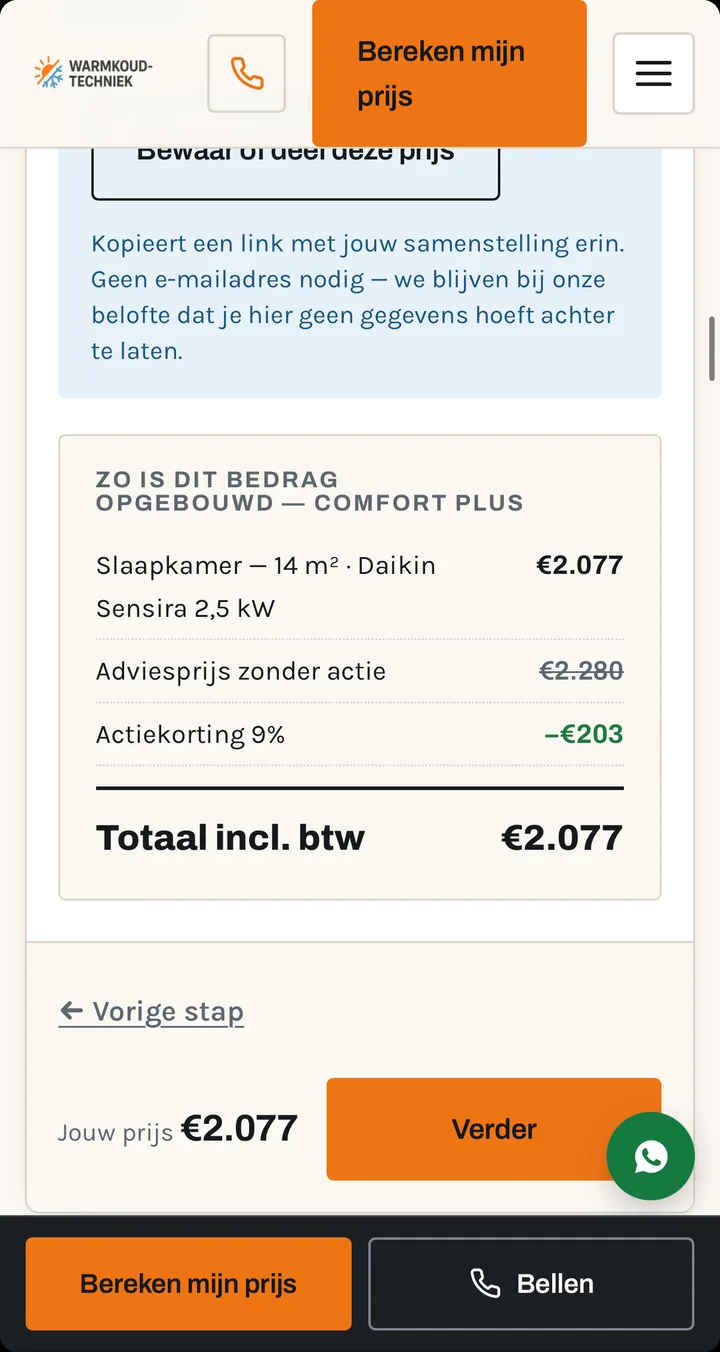
Yes, and it is often the better version. Instead of producing a quote faster, let the customer assemble it themselves. Then the work moves to the person who already had every answer, and they leave with a price before anyone has picked up a phone. Fewer steps, and no queue in the middle.
That is the same idea from the customer’s side, told through an installer who used to climb down a ladder about fifteen times a day.

Two closing notes on the numbers. Two hours, eight minutes, eight people and three people are the figures I can defend; there is no company name and no start date here because I do not have ones I trust, and inventing them would make the rest less believable. That is also why I keep the numbers narrow everywhere else on this site. If you want the general shape of this work rather than one case, it is described here: what this kind of work looks like from the inside.
Marc Herdes, Almere, 4 September 2026.
Does this sound like your company?
Two sentences is enough. You get an honest answer: what I would build, what I would leave alone, and whether it belongs with me or with someone else. A first conversation costs nothing.

Where does the time actually go?
Name the step where the same information gets typed for the second time. That is almost always where it starts.
Rather talk? 036 52 98 447 or marc@herdes.nl